Angola
Another Day of LifeAngola is both the setting and the central historical subject of Ryszard Kapuściński’s account: a large former Portuguese colony where the struggle for independence gave way to a war among armed political movements, then continued after the creation of an independent republic. The country’s immense territory, difficult borders and divided political control make the landscape more than a backdrop. They help explain how campaigns could converge on Luanda, how the capital could be isolated, and why the departure of foreign forces did not end the fighting.
Territory and Historical Background
The name Angola derives from N’Gola, a king who ruled the Mbundu people in the second half of the sixteenth century in the region around present-day Luanda. His kingdom, Ndongo, lay south of the powerful Kingdom of Kongo. Both states came under the rule of the King of Portugal and were subsequently destroyed. The account places the modern country within this longer history of conquest, rather than treating its political divisions as an isolated crisis.
Angola covers 1,246,700 square kilometres, making it the fifth-largest country in Africa by area. It is fourteen times larger than Portugal and larger than France, former West Germany, Great Britain and Italy combined. Its land borders total 4,837 kilometres, while its coastline stretches for 1,850 kilometres. The land frontier is not clearly demarcated in places: it runs through uninhabited bush that can be crossed at will, even by car. For a country surrounded by unfriendly neighbours, this openness creates a serious defensive problem. Its sheer scale and porous borders help account for the difficulty of securing the territory and for the importance of roads linking the interior to the coast and the capital.
Portuguese rule also left a social and political legacy. For centuries, Angola served as a penal colony and a destination for people deported from Portugal, including criminals and social outcasts. The account connects this history to the country’s economic and educational backwardness. By the middle of the twentieth century, however, a liberation movement had begun to take shape. In 1948, young Angolan intellectuals formed the cultural movement Vamos descobrir Angola and published two issues of the literary journal Mensagem before police closed it down. Its editor, Viriato da Cruz, worked alongside the poets Agostinho Neto and Mário de Andrade; the account identifies these three figures with the rise of the liberation movement.
Independence and the Contest for Luanda
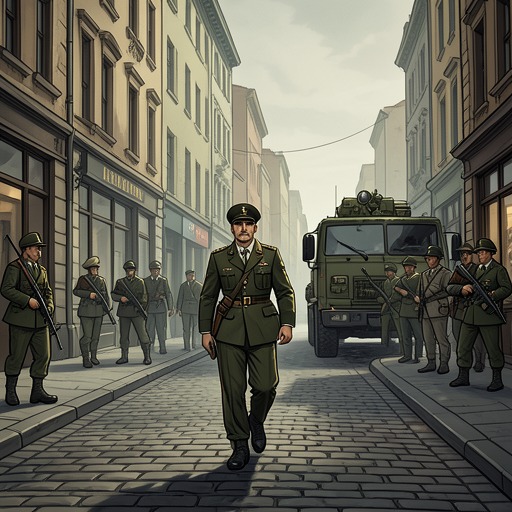
The war began in the spring of 1975, after Portugal’s new rulers granted Angola and the other former colonies the right to independence following the overthrow of the Salazar dictatorship. Several armed political parties then fought for power, often at the cost of Angolans’ lives. The conflict was described as persistent and cruel: allegiances were uncertain, and no one could be sure who would be killed, by whom, or where. While people fled the country, Kapuściński travelled in the opposite direction. In Lisbon, he persuaded the crew of one of the last Portuguese military aircraft flying to Angola to take him. From the descending plane, he saw Luanda as a white patch surrounded by sunlight.
The struggle for the capital was also planned as an international military operation. Operation Orange aimed to occupy Luanda by 10 November 1975, the date and hour at which the Alvor Agreement stipulated that the last Portuguese units would leave Angola. The plan was to announce independence the following day and transfer power to an FNLA–UNITA coalition government. Its forces were to advance on three routes: south from Tsumeb through Pereira d’Eça, Lubango, Benguela and Novo Redondo; north through Maquela do Zombo, Carmona and Caxito; and east through Nova Lisboa, Quibala and Dondo. The southern column included motorized South African Army units alongside Portuguese volunteers and forces associated with the FNLA, UNITA and the Chipenda faction. FNLA units, supported by forces from Zaïre and Portuguese volunteers, were assigned the northern and eastern approaches. The coordinated routes reveal the strategic pressure placed on Luanda and the foreign participation in the contest for the capital.
On 19 October 1975, the first Cuban Army unit arrived in Luanda. On 11 November, Angola became a republic under the MPLA’s program: principal natural resources and major elements of the economy were to belong to the state; citizens were to have rights to employment and education; and the new government announced a policy of positive neutrality. Agostinho Neto became the republic’s first president. Independence thus established a government and a political program, but did not settle the conflict over who would rule the country.
Frontiers, Armies and the War’s Human Scale
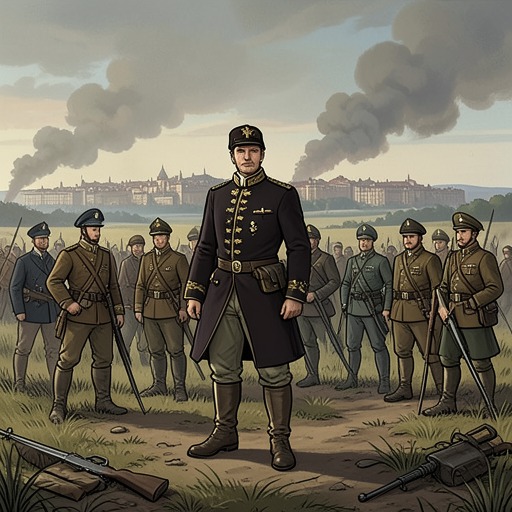
The front in the south shows how the country’s physical obstacles shaped the fighting. After flying over Porto Amboim and the wide, dark Cuvo River, Kapuściński saw a destroyed bridge, a motionless column of twenty-one armoured vehicles, trucks towing artillery and five jeeps at the rear. The road appeared to end at the river because the bridge had been blown up. At the front, the South African units could not cross while they waited for pontoon bridges; both sides exchanged sporadic fire but felt too weak to attack. The river and the destroyed crossings turned a line on a map into a practical barrier, delaying the advance and fixing the front along the bank.
The uniforms at that front also blurred distinctions between Angolan and Cuban forces. A soldier who drove Kapuściński towards the front was from Havana, though at first the correspondent had asked him in Portuguese whether he came from Luanda. Cuba had supplied uniforms to many MPLA units, and opponents feared Cuban troops so strongly that they sometimes fled from units in Cuban clothing even when no Cuban soldiers were present. Because both MPLA and Cuban forces were multiracial, skin colour offered no reliable clue either. These appearances helped foster a legend of 100,000 Cubans fighting in Angola; the account gives a much smaller total for the army defending the republic, no more than 30,000 soldiers, about two-thirds of them Angolan.
The physical setting of the front was improvised as well as strategic. Headquarters occupied large cotton warehouses, where soldiers walked through cotton up to their knees and slept in the warm, comfortable building. Meanwhile, a ship was expected to bring two Cuban companies and a company from Guinea-Bissau, while two MPLA units were travelling overland. After a night battle east of Porto Amboim, wounded local and Cuban soldiers lay on the floor of the returning aircraft. The episode brings together the war’s geography, its international contingents and the bodily cost of trying to force a river crossing.
A Republic Still at War
The book’s later perspective refuses to treat independence as a clean ending. From 1976 to 2000, the war continued as one of the longest armed conflicts of the contemporary world. Cuban and South African forces eventually departed, but Angolans remained in a country divided, devastated by civil war and still facing a central government challenged for decades by Jonas Savimbi’s rebellion. Government oil deposits and Savimbi’s diamond mines supplied both sides with substantial revenues, helping sustain the conflict. The account estimates that perhaps a million people had already died and warns that the list of victims would continue to grow.
Angola’s meaning in the book therefore changes across its chronology without losing its central contradictions. It is a place of enormous area and difficult-to-defend borders, a territory shaped by conquest and colonial rule, and the prize of competing liberation movements and foreign-backed forces. Yet the departure of outside armies does not restore a settled country. The final return to people encountered during the war, including the possibility that Farrusco’s son might one day serve as an officer, makes the conflict’s persistence intimate as well as political: the future remains bound to the front that was supposed to belong to the past.